|
|
|
|
| Book a call · Email me · Start an application |
 |
A little humor to start off – the “interest rate jitters” prank
Last month I hastily sent out a newsletter with my office address in the subject line, instead of the subject. I was playing around with the settings for my address on Constant Contact, and somehow, I managed to type my office address into the subject line instead of the field I should have put it in. Boneheaded move. Oh well, it happens to the best of us, and I’m not really a super techy guy (but learning).
Reminded me of this funny story, from about 15 years ago when I was fresh.
I was sending out a newsletter titled “Interest rate jitters?” A few minutes after I hit send, my prankster friend emails me a one-liner: “Interest rate *itters?! David, what are you thinking!!??”
I immediately froze and went cold, picturing the offensive word in my subject line, and how that could have been a typo so easy to miss. I read his sentence one or two times and began kicking myself.
Now, a smarter person would have taken one more minute to re-check the original email, and not go into immediate panic mode. I didn’t (check my email), and did (go into panic mode). I immediately drafted up an apology email, read it twice, and hit send.
Then, a second email from my prankster friend: “David! It was a joke!”
Face slap. I hadn’t made any mistake in my original email, and then sent out an apology to my entire list for an offensive word that was never there.
Ah well. Sometimes, no matter how many previews I send myself, this stuff will happen. Thank you, as always, for staying subscribed and reading.
|
|
|
 |
Economic update: The Ups, The Downs
The Bank of Canada held its overnight rate at 2.25% on September 2, the seventh scheduled announcement in a row without a change. The next BOC rate decision is on Wednesday, October 28.
There is talk that rates could be going up due to inflation, but traders put the odds of a hike at only about one in three. The rest are feeling like it’s going to stay steady.
I’ll break down both reasons why rates could go up, but also reasons why rates could go down. I’ll sum up with what I think you should do, if you’re in decision making territory.
Why the hike talk?
- Inflation is running around 3%. It was 3.0% in August, and most of that is gasoline, which is the Iran war showing up at the pump. Take gas out and it was 2.4%, up from 2.2% in July. The Bank has also flagged new tariffs between Canada and the U.S. as a risk to prices.
- The economy bounced back. GDP grew 3.3% in the second quarter after a very weak first quarter, with some rebound in housing activity.
And why can rates hold steady?
- Jobs are soft. Canada lost 42,000 jobs in August and unemployment sits at 6.4%. The Bank says demand for labour “remains subdued.”
- Economy is sluggish still. Yes, GDP bounced back in the second quarter, but it was bouncing off a very weak first quarter, and the Bank itself flags “risks to the sustainability of the recovery” from the new tariffs. Retail and wholesale trade have shed roughly 55,000 jobs over the past year. Fewer paycheques means less spending, and less spending cools inflation on its own. A rate hike on top of that is a brake on an economy that’s still struggling to pick up speed.
Both of the above give us a central bank pulled in two directions. The odds of a hike were close to a coin flip in late September and have come down since. Economists are split.
What I’m NOT Watching: Bond yields. What I AM watching: Factors that AFFECT bond yields
Fixed mortgage rates follow bond yields, not the Bank of Canada overnight rate. At a bond market session I attended a couple of months ago, one line stuck with me: bond yields hate uncertainty. When the uncertainty is about prices, markets bake in more inflation, and when they expect inflation, yields go up. This past year handed the market plenty to worry about. The war with Iran sent oil and gas higher, and the tariff fight with the U.S. keeps everyone guessing. The 10-year Government of Canada yield is up about three-quarters of a point in 12 months, and fixed rates have moved with it.
So, pray tell: what’s happening in November, politically? If you guessed the U.S. midterm elections on November 3, you’re right.
The bond market doesn’t care how you vote, and neither do I. It cares how much uncertainty is left when the votes are counted. With the president’s approval sitting at or below 40% in most polls, it’s reasonable to expect the balance of power in Washington to shift, and with it some of the policy swings that have rattled markets. Less uncertainty tends to bring yields down, and fixed rates follow. On the other hand, if we get a messy result, a gridlocked Congress, or a budget fight, bond yields may do the opposite (go up). Betting markets are leaning towards the political shift, which will remove some uncertainty, and, hopefully, bring down yields.
The other half of my thinking is our own economy. In short, it’s not doing stellar. We lost 42,000 jobs in August, unemployment is 6.4%, and most of our inflation is gasoline. Weak jobs and soft spending eventually pull inflation and yields down, and they push the Bank of Canada toward cuts instead of hikes. I won’t say that’s certain. Inflation is still around 3%, so the Bank is stuck between the two.
All of this is prediction. Anyone who tells you they know what’s coming is guessing, me included. Economists really are torn, and as I always say, they’re wrong 50% of the time, so take what they say, and what I say, with a grain of salt.
| |
What To Do About Your Mortgage Rate Decision
- Think about the variable cushion. The variable rates I’m offering sit three to four Bank of Canada hikes below what the fixed rates are right now. Three to four hikes from the current prime of 4.45% would put the Bank at the top of its own neutral rate and definitely slow our economy further. So, some hikes may come. Nothing like 2022 and 2023, when the rate went from 0.25% to 5%, because we’re already starting from the neutral range. Each hike costs roughly $50 to $60 a month on a $400,000 balance amortized over 25 years.
- Mind the gap. Look at the rate spread between the best fixed rate and the variable rate. If the gap is small, and, if you’re a more risk averse sort of person, lock the fixed. You’re paying a little more to take the risk off the table. If the gap is wide enough to absorb three or four rate hikes, and if you’re a less risk averse kind of person, take the variable. Wait for fixed rates to come down, and lock in when you think (or when the consensus thinks) rates are at their lowest. Remember, most, if not all lenders give you the option of locking in a fixed rate with no penalty. Take the variable, wait for rates to come down, then lock in.
|
Renewal coming up, or watching a variable rate? Book a 10-minute call or call 250.858.7160.
Sources: Bank of Canada; Statistics Canada; Bloomberg and Kalshi market pricing as of early October; U.S. polling averages.
|
|
|
| |
 |
Current rates
These are the rates I’m offering as of October 6, 2026.
| Product |
Rate |
| Variable, 5 year, high ratio |
3.50% |
| Variable, conventional |
3.69% |
| Fixed, 3 year, high ratio |
4.44% |
| Fixed, 5 year, high ratio |
4.54% |
| Fixed, 5 year, conventional |
4.69% |
- Existing deals cannot be repriced.
- Your rate depends heavily on your transaction and your qualifications.
Want to know where you’d land? Book a call or start an application.
Rates as of October 6, 2026, subject to change without notice. All rates are O.A.C. (on approved credit). High ratio rates are for insured mortgages and conventional rates are for uninsured mortgages, and eligibility applies. Existing deals cannot be repriced. Your rate depends on your transaction and your qualifications. For information only, not an offer of credit.
|
|
|
| |
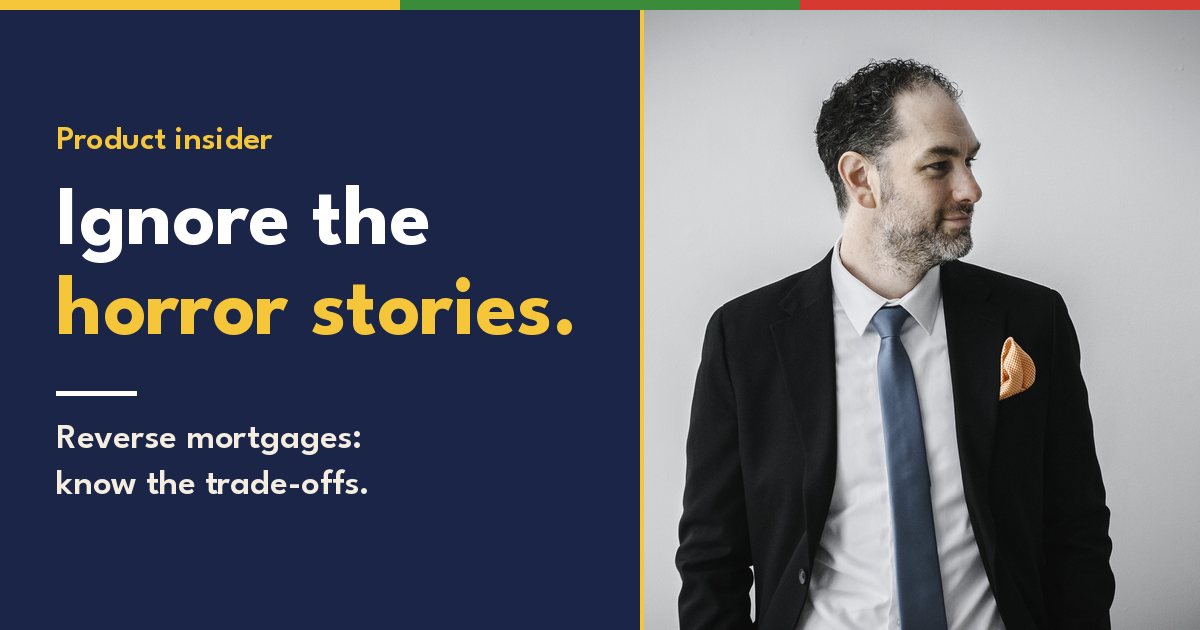 |
Product insider: what’s the deal with reverse mortgages?
First of all, ignore all the horror stories you’ve heard about reverse mortgages. Just like any other financial product, you have to consider the costs, the trade-offs, and whether it fits what you’re trying to do.
Here’s how it works, what the stories get wrong, what they get right, and who it fits.
How it works
If you’re 55 or older, a reverse mortgage lets you borrow against your home’s equity without selling and without making regular payments. You can access up to 55% of the home’s appraised value, and the older you are, the more of that you can reach. With two borrowers, both need to be 55+, and the younger one’s age sets the amount. The money is tax-free. Instead of monthly payments, interest is added to the balance, and the whole amount is repaid when you sell, move out, or the last borrower passes away.
What the horror stories get wrong
- “The bank takes your house.” No. You keep title and full ownership, and you stay for as long as you want to live there, as long as you keep up the property taxes, insurance and maintenance.
- “My kids will be stuck with a debt bigger than the house.” HomeEquity Bank’s CHIP reverse mortgage carries a no-negative-equity guarantee, so the amount owing can’t exceed what the home sells for, with some exclusions such as administrative expenses and interest accumulated after the due date. Ask any lender you’re considering whether theirs does too.
What they get right
- The rate is higher, and it compounds. Reverse mortgage rates run above a conventional mortgage or HELOC. With no payments, interest is added to the balance and then earns interest of its own. Illustration only: at 6%, a balance roughly doubles in 12 years.
- Your equity shrinks over time. That means less left for your estate. That’s the trade you’re making.
- There are costs. An appraisal, independent legal advice and set-up fees up front, and paying it out early can trigger a prepayment charge.
- There’s less competition. Only a handful of lenders offer these, and terms differ between them, so comparing matters.
Who it tends to fit
Homeowners 55+ with significant equity who want to stay in their home and don’t have the income to qualify for a conventional mortgage or HELOC. People use it to pay off an existing mortgage or line of credit, renovate so they can stay in the home longer, top up retirement income, or help family.
Who it doesn’t
It’s usually a poor fit if you expect to move within a few years, if leaving the house to your family is the priority, or if you can qualify for a conventional mortgage or HELOC, which usually costs less.
I’ll run the numbers, show you the alternatives, and tell you plainly if a reverse mortgage is the wrong tool. If you’re looking at this for a parent, bring the family to the call. Book a call or email me.
|
|
|
 |
Talk soon,
David Steinberg
Mortgage Strategist, Olympic Mortgage Corporation
|
250.858.7160 · david@olympicmortgages.ca · olympicmortgages.ca
|
|
A renewal, a purchase, or a parent asking about home equity?
Or just reply to this email, or call 250.858.7160.
|
Olympic Mortgage Corporation · Licensed mortgage brokerage, BCFSA #145716
General information only, not personal financial advice. Products, amounts and terms vary by lender and are subject to approval. |
|