Thank g-d I didn’t have any money invested in Bitcoin, myself. Yeesh. That stuff is way too risky.
It’s a long one today. In summation, I’m going to talk about the tech bubble/stock bubble, what Tiff Macklem is actually saying to us, what’s going to happen when the bubble bursts, and finally, the kicker, what it means for interest rates (but very briefly).
I’m already in the midst of the next article too (the more practical one, the one that applies to you). Like, what this all means for choosing between variable and fixed, long term versus short term interest rates, how to strategize potential purchases, etc, etc. Stay tuned.
But First, My Conversations With AI
I’ve been using AI alot lately. Not to make fun looking images (but I might start that too). Really, to bounce my ideas off of it, gain it’s insights, and using it to give me very well organized information. It’s been really good so far, and it’s getting better.
Note – you have to ask AI the right questions, and give it some variables so it doesn’t go too off track. I try to do that in all my questions. The better the questions, the better the answers.
I came up with a cool idea. I’m going to share some of my conversations with AI, with you. But let’s make it a game. Each time I write a blogpost, I’m going to change the password on my “conversations with AI” webpage.
Each week it may get harder or easier to find the password. You basically have to read the article to find it, or at minimum, get good at knowing where I’ll hide it.
Ok, let’s get into this week’s doozy.
First of all, they’re subconsciously telling you to be worried about interest rates.
Think about it. Every few days we get another near meaningless (*not completely meaningless), economic statistic (0.68% drop in jobs rate! 1.33% increase to GDP!) and then “they” (the media in this case) ultimately try to use that statistic to predict what’s going to happen with interest rates.
Most of the articles are the same.
But is the interest rate the only factor we’re thinking about?
It shouldn’t be.
The articles and commentaries don’t have much long term actual economic reporting. Instead of just focusing on what happens to the interest rate, how do these statistics really affect our daily lives?
(Are the writers themselves just being coerced into writing exactly what they know gets more reads?)
Yes, this is me, constantly calling out our general media for missing the mark. They’re only doing some of the reporting, they aren’t covering the complete stories.
It’s no surprise that Jeremy Powell and Tiff Macklem are constantly in the limelight.
People look to Tiff and Jeremy as the people that control what’s happening in the economy. If I wanted to go viral, I might start saying stuff like: Tiff Macklem, for prime – minister!
Anyways, Tiff made a speech on Thursday. Not really about interest rates or what’s going to happen with the economy. Here’s what Tiff is really trying to get across: He’s saying that he’s only the “messenger” of bad economic news. Like, the tarot card reader, except the tarot cards are these hundreds of random economic figures that he has to put together and made sense of.
GDP. Employment. Trade Disputes. Supply and Demand. Just to name the main ones. The actual flow of money through our economy.
He’s also saying that credit doesn’t control the economy.
Sort of like, he’s our country’s accountant. He doesn’t control the economy with rates, he just keeps the books and tries to “help” by raising or lowering interest rates.
Tiff Macklem can’t himself control the economy. Interest rates just act as gas on the fire (to get the fire going), or the fire extinguisher on the massive fire (to help put it out).
However, he still has to be careful about it.
He’s also saying that even though he doesn’t control the economy, he has to be careful with that accelerant. You don’t want to use too much gas on your BBQ and burn your food or your eyebrows.
Interest rates will help things swing in the right way. Make credit more available to people, and they will spend more money. Make credit more expensive, and they will spend less money.
Yes, one thing is true. We’re an economy dependent on credit.
Side note, no wonder it’s become so hard to obtain a mortgage. Banks and governments know that our economy are far too dependent on debt, so they’re putting the squeeze on it.
(Don’t let this sentiment stop you from trying to get a mortgage, just give me a call and I’ll let you know if it’s possible, or not).
Tiff is also trying to tell us to beware of an economic storm.
He’s reading the tarot cards. So what is he worried about? Let’s take a look under the hood, here is an important part of the economic story (WE ARE LOSING REAL JOBS).
Losing real jobs is a very bad thing. It means more people become dependent our system, and more people who cant buy things.
And this is important because our economy also runs on consumerism.
You heard it here, first. The tech bubble.
Tiffs worried about our economy losing REAL jobs, which is a true indicator of economic weakness. But there’s another impending disaster looming: The tech bubble.
Yes, we’re in a tech bubble, and I’ll tell you why, below.
What prompted me to start writing the article is, Bitcoin lost half of it’s value recently. Sure, it regained some of what it lost, but it’s showing cracks.
Chat GPT is already telling me it’s happening.
My question to Chat GPT on this one:
Chat GPT: please look at the headlines for all the assets that lost value, last night. Like, bitcoin lost half it’s value. Amazon lost value. Are there other major assets or companies in trouble?
Let me spell this out, loud and clear: We. Are. In. A. Tech. Bubble.
Amazon’s stock didn’t just lose value. Amazon is laying people off, en masse. And Amazon is one of the biggest tech companies, in the world.
Other companies that have laid large amounts of people off: Oracle, Workday, even the Washington Post.
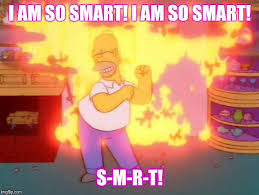
We as humans became too good in finding “tech” to replace “people”. Congrats humans. We’re, really Smart.
So companies like Amazon may be experiencing a reckoning. If Amazon can’t make the same amount of money and employ the same amount of people, they are losing money. As are many other tech companies, too.
Its like everyone’s waking up and realizing, that the machines don’t just “give everyone” money.
They help concentrate more of the money with a select few.
Anyways, as people lost confidence in the Bezo’s, Musk’s, Gate’s and Zuckerburg’s, – we realize we may be in bubble. These massive companies just aren’t worth what the stock price tells us.
Go to the Chat GPT Page today to my convo with Chat GPT about tech bubbles and world events.
Password: blog
Here’s what you’re going to see, very shortly, in this now Tech bubble that we’re living through.
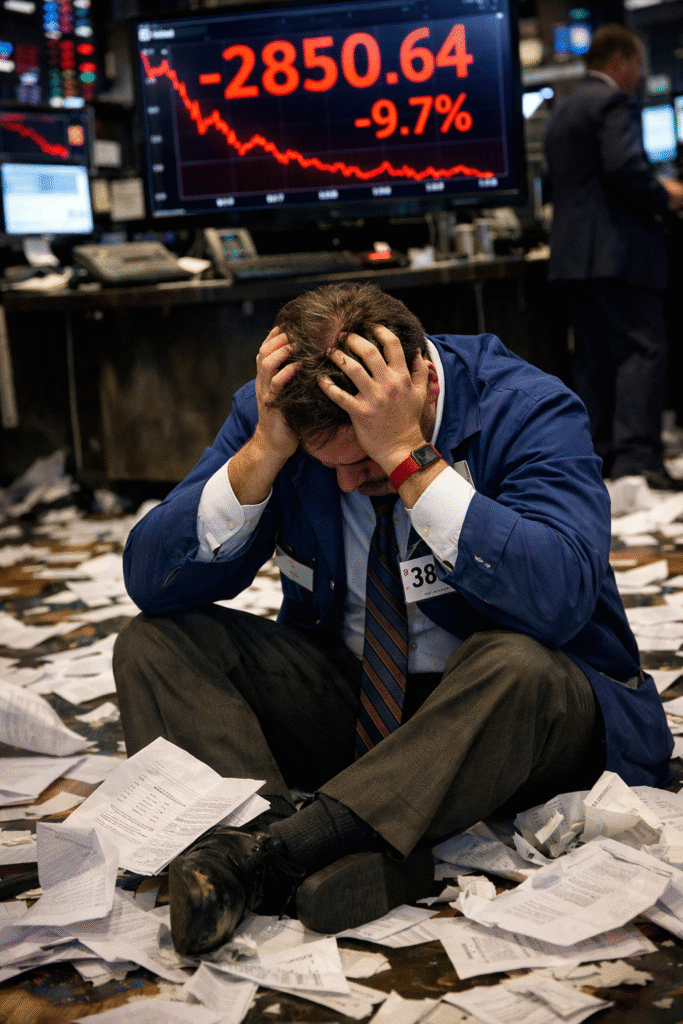
First, it’s going to be Black Friday, or Scary Tuesday, or whatever they are going to call it. The images of despondent stock traders with their head in the hands, amidst papers all over the ground of the exchanges.
That one dramatic day where stock markets lose about half of their value, once every realizes that it was all based on speculation. BOOM! Here’s an image chat gpt made for me, for this:
In the after effect of stock values plummeting,
people are going to be moving their assets away from more speculative assets, to less-speculative assets (IMPORTANT!)
There’s going to be a bunch more people that say now’s the right time to get out of the risky assets like crypto, and put it into the safe assets.
People will move massive amounts of stock and crypto into safer avenues, like fixed income bonds, mortgages, bank accounts. Safe fixed income assets, and real estate.
You’re seeing it happening right now. People are starting to lose confidence in the tech industry. The cracks are appearing.
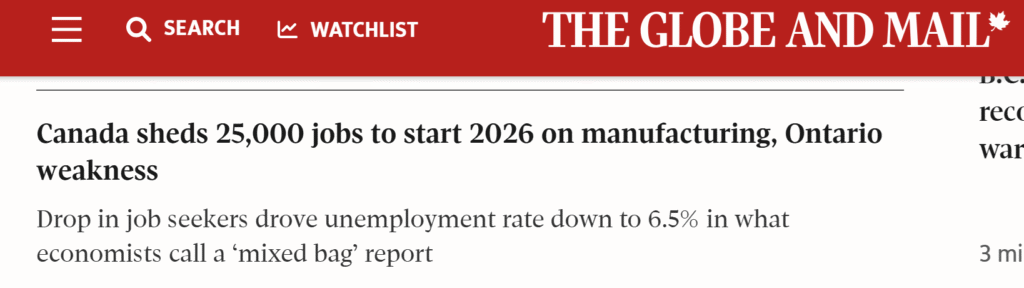
But the media are ignoring it, and feeding us headlines:
However, read the sub headline, the one they buried:
“Despite Amazon skid, market at ALL TIME CONFIDENCE!”.
Firstly, What absolute trash.
Secondly, these are exactly the type of headlines that we see before some major stock crash. Exchanges at all time HIGHS!
Do we really think we can continue at all time highs, all the time? Are we stupid?
We should be reading into the actual headline,
Amazon is losing money. They just laid people off, so really, Amazon isn’t worth what the stock price is telling us. Amazon’s bubble may just have burst. The air leaking slowly though. Amazon is obviously not going to lose all it’s value, just a significant amount.
We’re going to see more bubbles burst, and leak slowly. Or quickly.
Think, Enron.
Also from Chat GPT: Enron’s collapse in December 2001 shattered investor confidence and froze credit markets, accelerating a broader economic slowdown that helped tip the U.S. into recession.
Stock markets plummeted.
In a stock market crash, there will be massive amounts wiped off exchanges. People will think twice before inflating a tech stock’s worth (they won’t reinvest). Lots of people will lose jobs and money. It happened with Enron, and it’s happening again now. Why can’t we learn?
Real Economic Effects of a tech bubble:
More people will be out of jobs. GDP will go down, because more people have less money and less income.
Our economy moves into a recessionary period.
Lo and behold, when world events or stock crashes cause recessions, rates get cut.
And it’s not on one of the 8 per year pre-determined rate announcements. It’s an emergency announcement. It happens every time (2001, 2008, 2020 to name some). It’s Tiff and all his buds way of trying to give some life to a clearly limping economy.
Everyone’s borrowing comes down to ease the pain, in the outset. But then what happens?
What is a recession?
Technically, a recession is when we have two quarters of negative GPT Growth.
Look at what started the depression. 1929 stock market crash. 20% to 30% unemployment. Recession or depression depends on how deep it goes and how long it lasts. We aren’t going to see a depression, thankfully.
And what else happens in recession? Some people’s standard of living goes down. Savings dwindle. More people become a drag on the economy, and less people are able to spend money, or save money, or invest money. Because they don’t have, money.
We are probably heading into a little bit more of a recession, brought on by the tech bubble bursting. Hey, crypto just lost half it’s value, last night.
Lower rates could help, but don’t prevent it.
We can’t keep depending on debt to pick us up. And we will learn that we shouldn’t be rapidly using tech to try and replace people. That’s bad for the economy.
We have to drag our economy out of the dumps with real work, getting the flow of money back to the right places.
If there’s a recession, does this mean I’m going to sell my home?
Remember, speculative assets versus non speculative assets. Is that in here somewhere?
No, you aren’t going to just sell your home. You’re going to get up in the morning, go to work, earn your paycheck, and pay your bills and your mortgage.
Your home is a non-speculative asset.
So the mortgage keeps getting paid, even in a recession?
No wonder I’m a fixed income and real estate guy. Because I always know, that before all else, people will pay their mortgage and keep their house.
Real estate and mortgages are paid back and don’t lose value (unless you sell your house), even when almost every other asset class are losing value. Most mortgages get paid, even in recession.
To prove my above point, foreclosure rates remain very low, even in recessionary periods (also from chat-gpt):
📊 What the Data Consistently Shows
✔ Canada’s mortgage arrears and foreclosure rates have stayed very low relative to countries like the U.S. even in recessionary downturns. ✔ Across the 2000s and 2010s, the published CMHC data shows foreclosure rates measured in fractions of percent, not large spikes like in U.S. markets. ✔ The Canadian banking system’s underwriting standards and mortgage practices have historically limited breadth of distress.
It’s the glue that holds everything together.
Debt is a CONTRACT to PAY something back. It’s not crypto, it’s not stocks, it’s not precious metals. It’s a PROMISE that someone is going to pay you back. A CONTRACT.
Debt is real. So is real estate.
It’s funny that it’s called real estate. It’s real. We can touch it. We can build shelter on it. We can get income from it, or we use it ourselves to live, and not pay rent.
Debt and real estate don’t just disappear, like 50% of crypto did, or 6% of amazon did. There’s no one coming to your yard and saying, your 10,000 square foot lot and house are now 9500 square feet, instead. Your real estate assets don’t trade like stocks on the exchanges.
That’s why fixed income assets and real estate are different.
They’re stable. They’re non-speculative assets.
Now, fixed income instruments will fluctuate in value when the interest rates change, but the original coupon, the original debt contract, always get’s paid back. It’s kind of like, fixed income assets and real estate are protected from the drama of the “market”.
Despite all the craziness that’s going on outside, you still have to pay me back. It’s a contract.
Summation up till now:
We’re in a tech bubble. When the bubble bursts it’s going to cause a recession. More people will be off work and looking for jobs. There will be more supply, prices may come down (hopefully). Once that happens, the other side kicks in. The cyclical economy.
Oh, and there will probably be an emergency rate cut. And eventually,
We’ll climb out of the recession.
Hopefully we will be smart enough to contain and climb out of the recession. Hopefully, we’ll figure out ways to put people back to work.
If we were smart, we will put our money and debt to good use. Fund more infrastructure, development, and social programs that make a difference.
Productivity will pickup.
For example, right now, our government is pumping lots of money into defense.
The other time we got ourselves out of a depression was by funding a war. The war movement spurred on the economy, and sent us into the 1950s with the most potential that we ever had. The middle class prospered throughout the 50’s and 60’s. What was this called? The golden age?
The middle class has to rebuild in order to really pull our economy out of the drags.
But not just put people back to work.
Put them back to work in meaningful jobs. To make a positive contribution to our economy. Positive contributions will help increase our GDP, and our standard of living.
When we see that our economy has more people back to work, standard of livings going up, no tech bubbles or other bubbles inflating things, and all the good stuff, we will climb out of the recession.
Yay!
And once we climb out the recession….
…….we’ll realize one thing was there all along. Our debt, and our real estate. And taxes.
They say that only two things are inevitable in life. Death, and taxes. I’d argue that debt and real estate are two things that are pretty inevitable, too.
And Finally, a disclaimer.
On the money manager title I gave myself this week, I’m not technically a money manager…….but I am. You see, I help people manage their debt. A debt manager, so to say.Debt is money, no?
Anyways, maybe I’m also foreshadowing here. I never called myself a money manager until now. And you know what? I sort of like it. Maybe it’ll stick, as I head into a newer but related venture, myself.
Signing off for now,
David Steinberg, Economist and Thinker, Money Manager
Olympic Mortgage Questions? Call 250.858.7160 Book a call · Email me · Start an application A little humor to start off – the “interest rate jitters” prank Last month I hastily sent out a newsletter with my office address in the subject line, instead of the subject. I was playing around with the settings for […]
Olympic Mortgage Market update September 2026 One week later THE BANK HELD. HERE’S WHAT MATTERS NOW. The overnight rate stayed at 2.25%. Mortgage pricing didn’t. It’s been a week since the Bank of Canada held its overnight rate at 2.25%. That’s enough time for the headlines to fade and for the […]
Economic update · week of August 31 The Bank of Canada decides Wednesday, and the data is pulling both ways. The announcement lands Wednesday, September 2. Going in, the case is genuinely mixed — three things are pushing in different directions at the same time. Friday’s GDP number came in better than […]
No matter where you are in the buying process, its always the right time to setup a call with a mortgage specialist!
At Olympic Mortage, we want the best for the people around us. We care for our clients, whomever they are, wherever they’re from. Everyone gets the best of us, because that’s what we want to be putting out to the world. So go ahead, try us.
CONTACT DETAILS
Suite 103, 2311 Watkiss Way, Victoria, BC, V9B 6J6